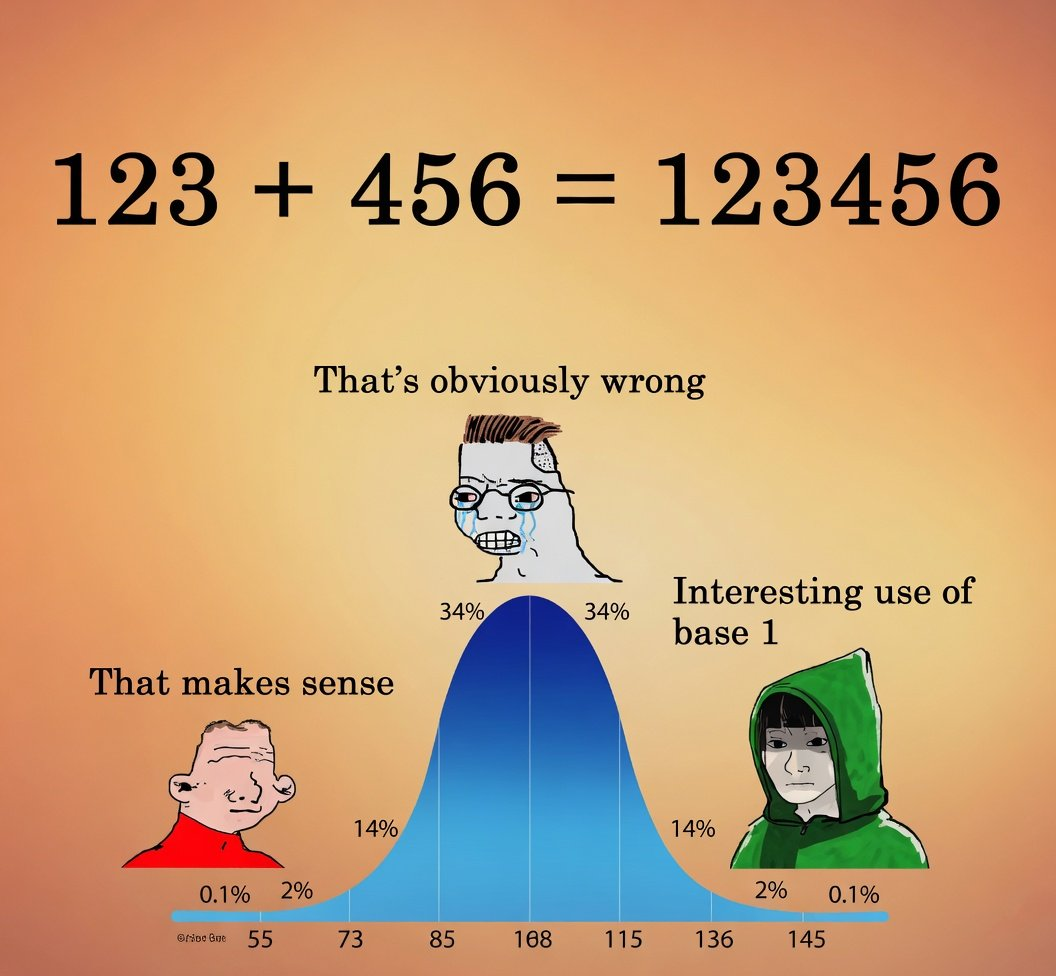

In base 1 there would just be 579 ones in a row. Someone doesn’t understand base 1.
123 + 456 = 123456 Or translated to decimal 3 + 3 = 6
Not exactly. In base 1 they don’t have to be in a row because the order doesn’t matter. For example, 16 could be 16 ones in a row, or 4 rows of 4 ones, 2 rows of 8, or 16 in a circle, an X, or a completely disorderly bunch.
JS devs are like yep, that’s clearly concatenation of 2 strings.
Came here for JavaScript mention, was not disappointed.
But for some reason 456 + 123 = Null.
Mathematicians too
Gardeners too

I came to complain about JS and see that I was beat to the punch
I mean everyone looking at that equation should think that
Compared to a type safe language where it would be an equation rather then concatenation.
Only when the first statement is a string already would that result in a string concat.
They are implied to both being strings. As such the first one already is a string. Neither is marked as such in a standard way though.
This is slop, look at the “108” in the middle. I hope you found it somewhere and didn’t realize it was AI-generated.
Oh and the watermark/attribution on the left. I guess someone put the original meme through an AI tool to colorize it. Weird.
Clearly it’s a lopsided theta!
I mean not really cause base one would just be 111 + 111 = 111111. On the other hand if its baseless it still doesnt work cause then its 3 + 6 = 9? But with that it could just be base 10. One thing that could work is that its actually a split base 4 and 8 system where the first 3 digits of a number are base 4 and the rest are base 8 but this is a very confusing system and the opposite of what is usual. It could also be a system where 1, 2, 3 are used for whole parts of numbers and 4, 5, 6 were added when they inveneted fractions so they represent the fractional part of numbers? Thats what im gonna put my money on tho im probably ignoring something obvious.
I disagree with you definition of base 1. Since base 10 is 0 through 9, and base 2 is 0 and 1, therefor base 1 must be only 0.
The real question is: How do we continue?
What is base 0?
Is that equal to base 1?
Are the negative bases?Base 1 is a tally system. The symbol can be anything as long as it’s discrete.
Base 1 is just run length encoding.
1: 1 2: 11 3: 111 ... 10: 1111111111That would be reverse run length encoding. Also, Base 1 is just zero, everything equals zero.
123 = 000 = 0
456 = 000 = 0
123456 = 000000 = 0
123 + 456 = 123456
0 + 0 = 0
69 + 420 = 42069
Base-n is a numeral positioning system where the value of each digit is n times the value of the dight directly to its right.
We typically don’t let the maximum digit we use to be greater than or equal to n because then there would be multiple ways to express the same number.
However when working with weird bases, sometimes it’s useful to forgo this convention.
And what about base e or fractional bases?
You can read all about those in The Lesser Key of Solomon
Base 0 has zero digits, so it would just be blank
This is completely true but i kinda shortcut to a zeroless base 1, basically a counting system. Another way you could make it work is of you had a seperate numeral for each factor of 2. So 1->1, 2->2, 3->4, 4->8, etc. So 123 is just 1+10+100->111 in base 2 so 123+456=123456 is true because 7+56 is 63. Idk i think we are overcomplicating a meme but thats what the internet is for and i think this system is actually not even that cursed.
I think they just meant modulo 1 instead
Popmath youtubers: “123+456=123456 😱” actual explanation depends on an obscure redefinition of numbers, + and =.
In this case it depends on having base 1 with all digits being equivalent (i.e. 123 = 456 = 000).
So effectively 3 + 3 = 6, just counting digits.
No, in this system 3 + 3 = 33 or 66 or 12 or 11, etc. Basically any digit is equivalent 1 in normal base 1.EDIT: I blame lack of coffee for misreading Serinus@lemmy.world comment
Yes they were correct.
123 + 456 = 123456 in base 1 (assuming all symbols are considered the same digit) would be equivalent to 3 + 3 = 6 in base 10.
that, or you’ve accidentally used
stringinstead ofint😅
Before anyone calculates this: it’s not possible in base 10 or any base because 3+6 ≠ 6
Oh, strings have no limiters, and + is the string concatenation operand?
Being in “this is obviously wrong” category, I have no choice but to downvote this.
It’s just a sum of the sets 123 and 456 where 123 +456 = 123×456
This holds when + is a group operation (concatenation) acting on the set of all possible finite strings.
I feel like this well represents one of my first coding mistakes in VB, right before I started way overusing conversion calls
I asked python to do this, and it checks out…
a = "123"
b = "456"
c = a + b
print(c)
123456
Mathing made easy.